
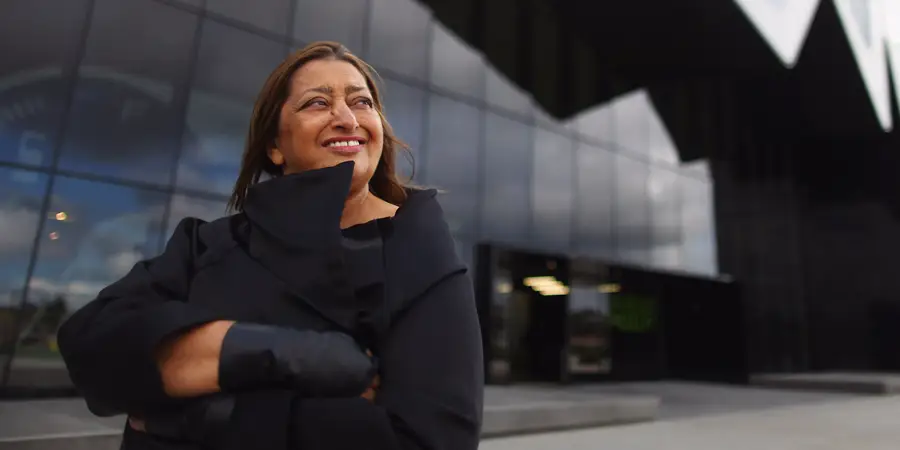
Few architects have bent steel, concrete and glass into as many poetic shapes as Dame Zaha Hadid. Born in Baghdad in 1950, Hadid grew up in a household where art, science and politics mingled. Her father Mohammed Hadid was a liberal Iraqi politician and industrialist, and her mother Wajiha al‑Sabunji encouraged her curiosity. In interviews Hadid recalled that mathematics, drawing, music and literature were everyday parts of her upbringing. She attended a progressive convent school where professors visited from universities to teach, instilling a belief that education could unlock possibilities for girls.
Hadid studied mathematics at the American University of Beirut before moving to London in 1972 to enrol at the Architectural Association School. There she studied under Rem Koolhaas and Elia Zenghelis, who later founded the Office of Metropolitan Architecture (OMA). Upon graduating in 1977 she joined OMA, but by 1980 she had established her own practice in London.
A new architectural language
Hadid’s early career coincided with a period of optimism and modernisation in the Middle East. She was fascinated by the Russian avant‑garde and used painting and drawing as design tools . Her bold canvases explored fragmented forms and dynamic compositions, prefiguring her buildings. In 1983 she won the competition for the Hong Kong Peak Leisure Club, a project that was never built but established her reputation for radical deconstructivist design.
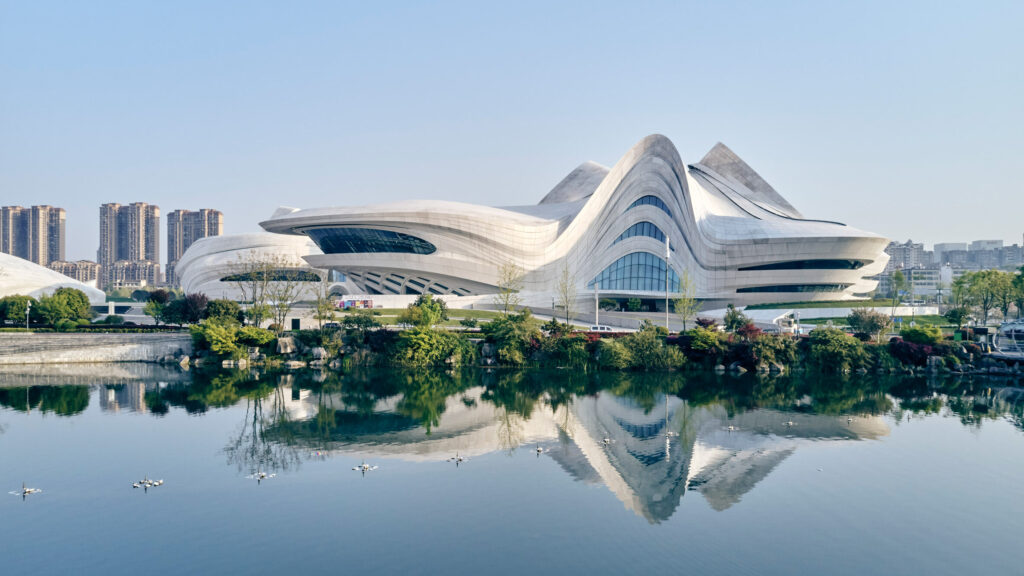
Over the following decades Hadid pushed architecture into new territory, experimenting with fluid spaces and complex geometries. The Zaha Hadid Foundation notes that she consistently sought to create “fluid space, in every sense,” dissolving boundaries between inside and out. Her work spans urban planning, interiors and product design; she saw no limit to the forms architecture could take.
Among her seminal built works are the Vitra Fire Station in Germany (1993), the Mind Zone at London’s Millennium Dome (1999), the Bergisel Ski Jump in Innsbruck (2002) and the Rosenthal Center for Contemporary Art in Cincinnati (2003. Later projects such as the MAXXI Museum in Rome, the London Aquatics Centre for the 2012 Olympics, Guangzhou’s Opera House and Baku’s sensuous Heydar Aliyev Center cemented her reputation as the “queen of the curve”. Her buildings appear to flow like liquid, using sweeping curves and sharp angles to evoke motion.
Hadid’s work has been shown in museums worldwide and collected by major institutions. She held teaching positions at Harvard, Yale, Columbia and the University of Applied Arts in Vienna, influencing a generation of architects. She famously said that there should be “no boundaries for people to move from one space to another” and sought to intensify urban landscapes through new spatial concepts.
Shattering glass ceilings
Despite her groundbreaking designs, recognition came slowly. For years Hadid faced scepticism as a woman in a male‑dominated profession and as an immigrant practising deconstructivist architecture. But her persistence paid off. In 2004 she became the first woman to receive the Pritzker Architecture Prize, the highest honour in the field. She later became the first woman to receive the RIBA Royal Gold Medal in her own right (2015) and twice won the Stirling Prize (2010 and 2011). She was appointed Commander of the Order of the British Empire (CBE) in 2002 and made a Dame in 2012.
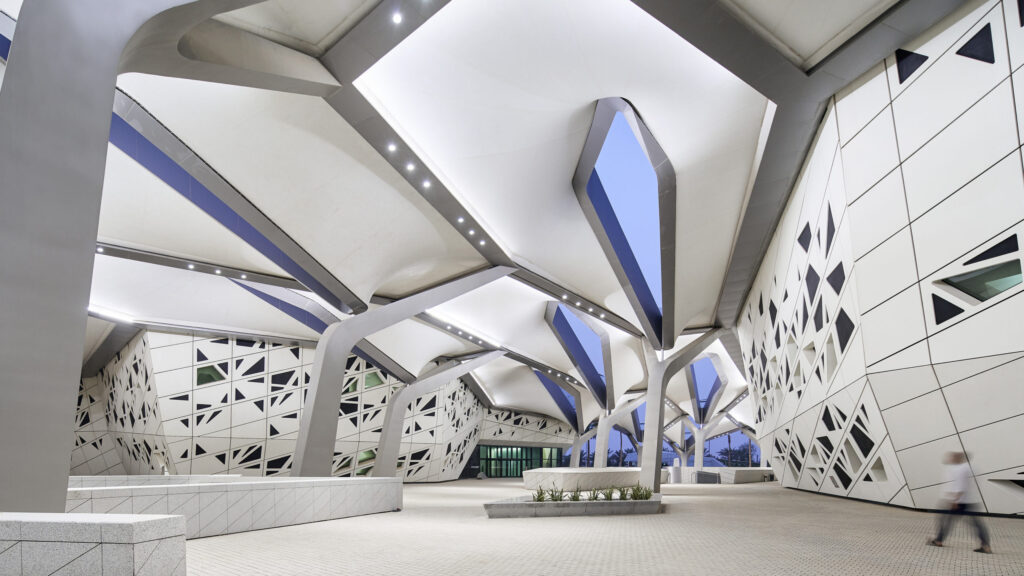
These accolades acknowledged more than just individual buildings; they celebrated Hadid’s role in redefining what architecture could be. Her practice, Zaha Hadid Architects, developed advanced parametric design tools and pioneered the use of digital modelling in construction. The firm’s projects continue to push technological boundaries, from high‑speed train stations to cultural centres across Asia and the Middle East.
Legacy of a visionary
Zaha Hadid died suddenly in 2016, but her influence endures. Her built projects remain landmarks, and her drawings and paintings are prized by collectors. Perhaps most important is the way she expanded the language of architecture. As the Zaha Hadid Foundation notes, she developed an “entirely new architectural language” and pushed the boundaries of what was thought possible. By combining mathematics, art and engineering, she showed that buildings could be dynamic, expressive and fluid. Her life is a testament to the power of imagination and tenacity — a reminder that even in the most rigid of disciplines, there is always room to redraw the lines.