
Where the Ancient World Learns a New Language of Luxury
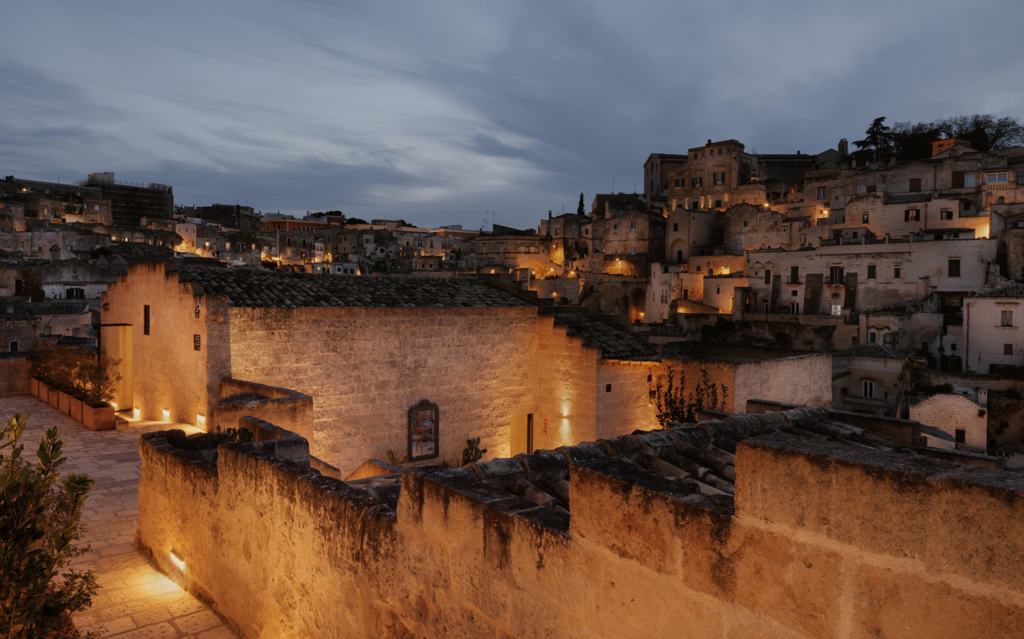
There are places that are beautiful, and then there are places that seem to carry the memory of humanity within their walls. Matera belongs to the latter. From across the ravine, the city appears less constructed than excavated from the earth itself: a labyrinth of pale stone houses, churches, staircases and caves layered one above another until it becomes almost impossible to understand where architecture ends and landscape begins. At sunrise, the Sassi turn the colour of honey. At dusk, shadows deepen inside the caves and the first lights begin to appear across the hillside. By night, Matera seems suspended somewhere between reality and memory, a city illuminated beneath a southern Italian sky that has watched generations come and go for thousands of years.
Hidden within this extraordinary landscape is Vetera Matera, a five-star albergo diffuso and member of Relais & Châteaux that approaches luxury in a way perfectly suited to the city surrounding it. There is no monumental new building, no architecture attempting to dominate the skyline and no desire to impose a contemporary identity upon something infinitely older. Instead, Vetera inhabits the historic Rione Vetera in the Sasso Barisano, its 23 rooms and suites distributed organically through restored ancient spaces, courtyards, terraces, stone passages and staircases. The hotel does not sit beside Matera’s history. It exists inside it.
That distinction is important, because Matera is not simply another picturesque Italian destination. Human presence in this landscape stretches back to prehistoric times, with caves in the surrounding Murgia providing shelter as early as the Paleolithic period. Over centuries, those natural cavities became dwellings, churches, workshops, cellars and communal spaces, creating an extraordinary settlement shaped by the relationship between human ingenuity and the land itself. The Sassi and the Park of the Rupestrian Churches were inscribed on UNESCO’s World Heritage List in 1993, recognition of a cultural landscape whose value lies not only in its beauty but in the extraordinary continuity of life carved into its stone.
Matera’s history, however, should never be romanticised into a simple tale of ancient beauty. During the twentieth century, the Sassi became synonymous with severe poverty and difficult living conditions, and large parts of the population were eventually relocated. The ancient quarters fell into abandonment before a remarkable process of rediscovery and restoration began to change their destiny. Matera’s transformation eventually carried it from national shame to international cultural prominence, culminating in its designation as European Capital of Culture in 2019. What makes the city so compelling today is precisely this complexity. Its beauty has scars. Its stones carry evidence of both hardship and extraordinary resilience.
Vetera belongs to this modern chapter of Matera, but its greatest achievement is understanding that restoration does not require erasure. The project was conceived around the careful recovery of existing spaces, preserving original materials and allowing the irregular geometry of the Sassi to determine the experience rather than forcing the site into the predictable structure of a conventional hotel. Rooms appear at different levels. Courtyards lead towards terraces. Stone stairways connect spaces that feel discovered rather than designed. The architecture remains wonderfully imperfect because perfection here would somehow feel dishonest.
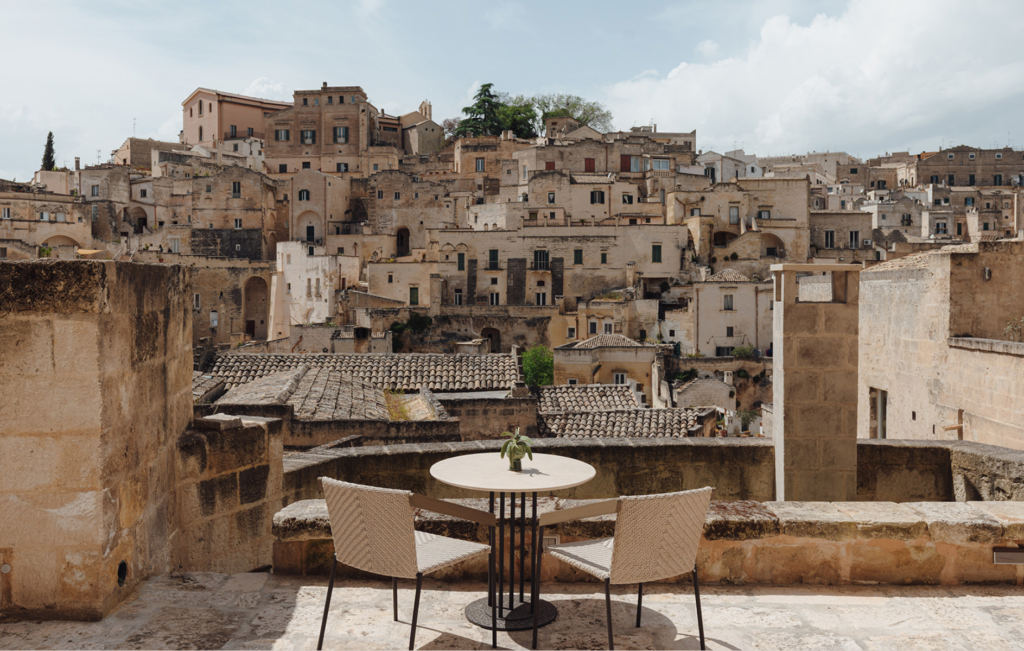
This is where Vetera begins to reveal a particularly sophisticated understanding of contemporary luxury. There was a time when luxury hospitality meant transforming every destination into the same immaculate world: polished marble, perfect symmetry, grand entrances and an abundance of decorative statements intended to reassure travellers that they had arrived somewhere expensive. Vetera proposes almost the opposite. The stone is allowed to remain rough. Walls follow the contours created centuries ago. Natural vaults are celebrated rather than corrected. Contemporary furniture enters quietly, aware that it is merely the latest occupant of rooms whose history began long before the idea of a hotel existed.
The result feels remarkably intimate. Rather than walking down identical corridors past numbered doors, guests move through an environment that retains the complexity of the settlement it once was. This is the essence of the Italian albergo diffuso: hospitality spread through an existing historic fabric rather than contained within a purpose-built structure. At Vetera, the concept feels particularly convincing because Matera itself is vertical, irregular and communal. The hotel follows that rhythm naturally. Its spaces rise through the Rione Vetera, connected by the pedestrian lanes and characteristic staircases of the Sasso Barisano.
At the heart of this philosophy is the vicinato, a concept fundamental to traditional life in the Sassi. Historically, dwellings were organised around shared external spaces where neighbouring families cooked, worked, talked and raised children together. The courtyard was not simply architectural circulation; it was a social centre. Vetera has allowed this idea to influence its own communal spaces. Its outdoor courtyard becomes a place for breakfast in the morning, coffee during the day and aperitivo as afternoon turns towards evening, while terraces positioned at different levels reveal changing perspectives across Matera. It is a subtle but intelligent way of preserving not merely the appearance of historical architecture, but something of the way it was once inhabited.
The guestrooms offer two very different relationships with the city. Above ground, the rooms and suites of the noble floors are characterised by high vaulted ceilings, generous windows, exposed stone and, in some cases, private balconies or terraces overlooking the Sassi. Light becomes an essential part of their character. Matera’s stone changes constantly throughout the day, appearing almost ivory beneath the morning sun before becoming warmer and more golden towards evening. From these elevated rooms, the city becomes a vast living landscape framed by windows.
Below ground, the experience becomes entirely different. Vetera’s hypogeal rooms and suites are carved directly into ancient tufa, surrounded by natural vaults and living stone walls. Entering them produces an almost immediate sensory change. Sound softens. The temperature settles. The brightness of southern Italy disappears behind you, replaced by carefully considered lighting and the extraordinary stillness that only subterranean architecture can create. Contemporary furnishings and refined finishes provide comfort, but they never attempt to overpower the stone. Here, the luxury is precisely the sensation of being enveloped by something far older than oneself.
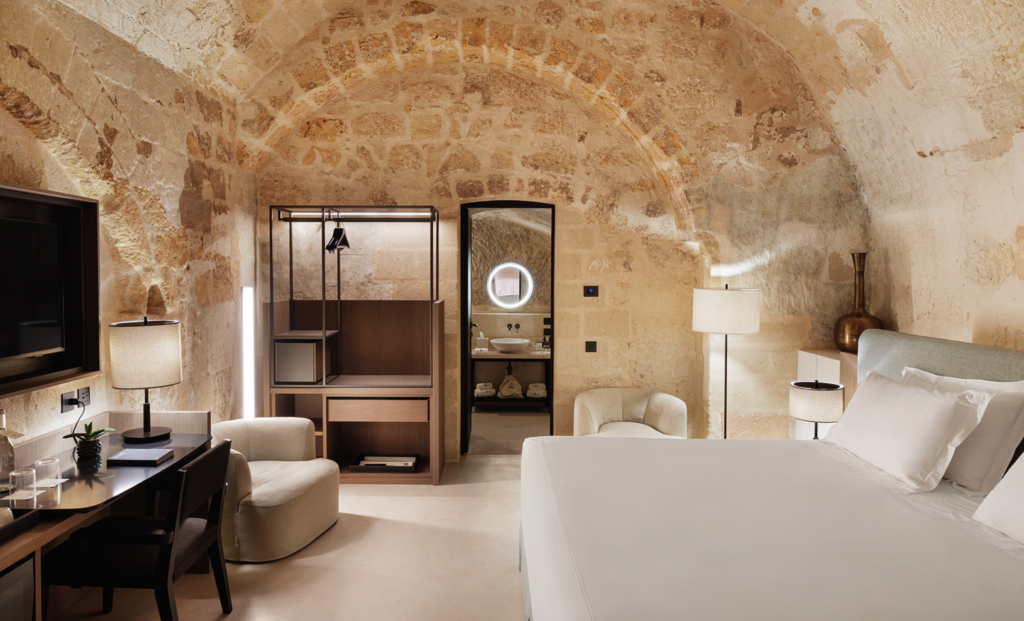
Some of the largest accommodations take this idea further. Vetera’s hypogeal Master Suites extend to almost 100 square metres and beyond, with one incorporating a private pool within the subterranean architecture. Yet even here, scale does not become spectacle. Water, stone and low light create an atmosphere closer to a private sanctuary than a conventional hotel suite. It is difficult to imagine a more intimate expression of Matera: sleeping beneath the city, surrounded by rock shaped first by nature and later by human hands.
Perhaps the most beautiful question when choosing a room at Vetera is therefore wonderfully simple: do you want to sleep inside Matera, or wake up looking across it? The hypogeal rooms provide an almost primal relationship with the earth, while the noble floors open towards sky, rooftops and landscape. Neither is necessarily more luxurious than the other. They simply reveal different sides of the same extraordinary place.
Morning is one of the finest times to experience the hotel. Before visitors fill the narrow streets and before the southern Italian sun begins to warm the stone, the Sassi possess an extraordinary silence. Church bells move through the ravine, birds cross the sky and the first doors begin opening along ancient lanes. Within Vetera’s courtyard, breakfast becomes part of this awakening rather than a separate hotel ritual. There is no need for theatre when the setting already provides it. A cup of coffee, fresh bread and the sound of Matera beginning another day can feel more memorable than the most elaborate breakfast room.
Then there is the food, and at Vetera it deserves more than passing attention. Artema, the hotel’s gourmet restaurant, occupies an underground room carved into the rock and is led by Executive Chef Eduardo Estatico. His cuisine draws together the Mediterranean with the landscapes of Murgia, Lucania and his native Naples, allowing southern Italy to become both inspiration and ingredient. Two tasting menus express this identity, while the wine cellar places particular emphasis on regional labels alongside a broader international selection. The restaurant is open for dinner, when the ancient stone and subdued lighting create an atmosphere that feels almost ceremonial without becoming formal.
This is exactly the kind of restaurant Matera deserves. The city would be poorly served by cuisine disconnected from its surroundings, no matter how technically accomplished. Basilicata possesses a culinary identity shaped by agriculture, scarcity and remarkable resourcefulness: durum wheat, bread, legumes, vegetables, peppers, cheeses, olive oil and ingredients that historically depended upon flavour rather than extravagance. At Artema, the opportunity is not to turn this tradition into nostalgia but to allow it to enter a contemporary conversation. Fine dining becomes most interesting when technique clarifies a sense of place rather than disguising it.
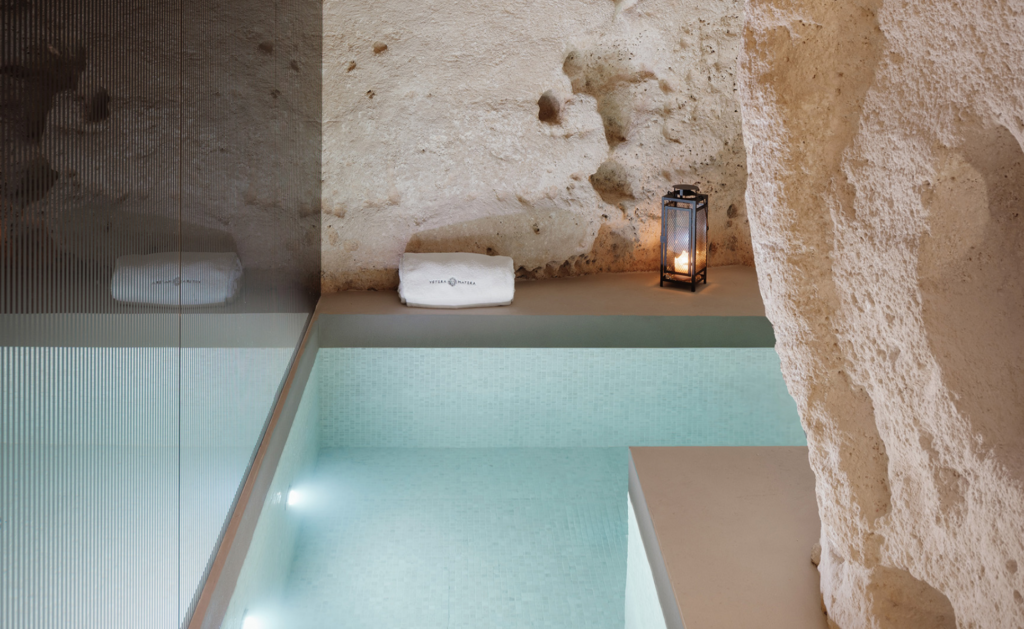
There is something almost poetic about moving from dinner deeper into the world of Vetera, because beneath the hotel lies another interpretation of the relationship between stone and human ritual. Elysium Spa unfolds through cisterns and caves carved into the tufa, transforming spaces historically associated with water and survival into places devoted to restoration. Its wellness journey moves between a heated hydromassage pool, hammam, Finnish sauna, frigidarium and relaxation areas carved into the rock, alongside treatments and personalised rituals. An outdoor solarium provides the counterpoint, returning guests from subterranean darkness to the extraordinary light of the Sassi.
The spa succeeds because it feels inevitable rather than added. In another hotel, a pool surrounded by stone might be a decorative concept created by designers. Here, the stone is real. The darkness is real. The sense of enclosure belongs to the architecture itself. Water reflects against irregular surfaces that were never carved for Instagram or wellness brochures. The experience is powerful precisely because the contemporary purpose is layered onto something ancient.
This dialogue between old and new continues in Vetera’s approach to sustainability. The hotel describes its restoration as low-impact, emphasising the recovery of existing spaces, preservation of original materials, use of natural materials and collaboration with local artisans and producers. As part of Relais & Châteaux, it also aligns itself with the association’s environmental commitments. Yet perhaps its most persuasive sustainable gesture is architectural: instead of replacing the past with a new luxury structure, it gives existing spaces another life.
Luxury hospitality frequently speaks about sustainability through what it adds—technology, certifications, new materials, new systems. Vetera offers another perspective: sometimes sustainability begins with understanding the value of what already exists. A wall that has survived centuries does not need to become new to become valuable. An abandoned cave does not need to lose its character to become comfortable. Preservation can itself be an act of contemporary design.
The hotel’s membership in Relais & Châteaux feels especially appropriate for this reason. The association has long championed independent properties where hospitality, gastronomy and a sense of place are inseparable. Vetera could not convincingly exist in another city. Remove the Sassi, the tufa, the vicinato, the staircases and the peculiar vertical geography of Rione Vetera, and the concept loses its meaning. Its identity is not applied to the destination; it is derived from it.
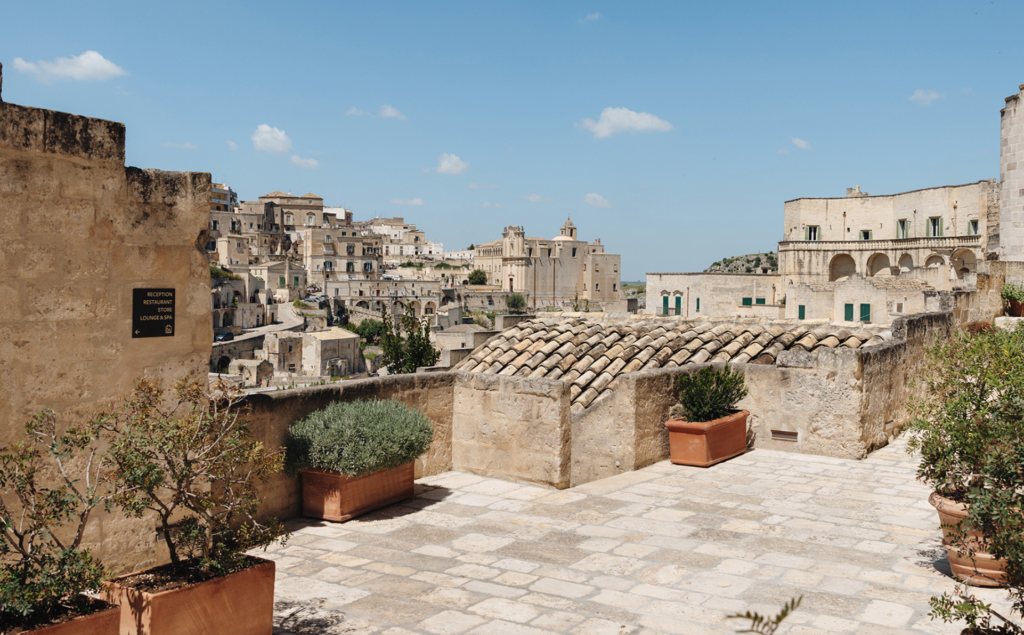
Stepping beyond the hotel reinforces this connection. Matera Cathedral is only around a hundred metres away, while San Pietro Barisano, Casa Noha, MUSMA and Palazzo Lanfranchi can all be reached on foot. But distances in Matera are deceptive. A three-hundred-metre walk may become a journey through centuries, involving staircases, tiny piazzas, cave churches, workshops and unexpected terraces overlooking the ravine. The pleasure lies in abandoning the idea of efficiency altogether.
Matera rewards wandering. A narrow passage that appears insignificant may suddenly open onto an extraordinary panorama. A simple doorway may conceal a rock-hewn church covered in fragments of medieval frescoes. Laundry hangs from balconies above architecture studied by historians. Children play football in squares that travellers cross with cameras. The city has become internationally celebrated, yet daily life has not entirely surrendered to its own beauty.
This is important, because the danger facing extraordinary historic destinations is that they eventually become stage sets of themselves. The more photographed a place becomes, the easier it is for real life to disappear behind the image visitors expect to find. Matera has experienced enormous growth in international attention, assisted by cinema and its 2019 cultural-capital status, yet its most compelling moments remain surprisingly ordinary: an elderly resident talking from a doorway, the smell of lunch moving through an alley, church bells interrupting conversation, a cat asleep on warm stone.
Vetera works best when it encourages guests to notice these things.
It does not need to entertain constantly because Matera is the experience.
By late afternoon, the city’s character changes again. The intense light begins to soften and the tufa acquires a golden warmth. Terraces become irresistible. From Vetera’s elevated spaces, the geometry of the Sassi gradually becomes easier to understand: roofs double as streets, staircases disappear between buildings and one century appears to sit physically upon another. A glass of wine at this hour feels less like an organised hotel activity than a reason to remain still long enough to watch the city transform.
Then darkness arrives.
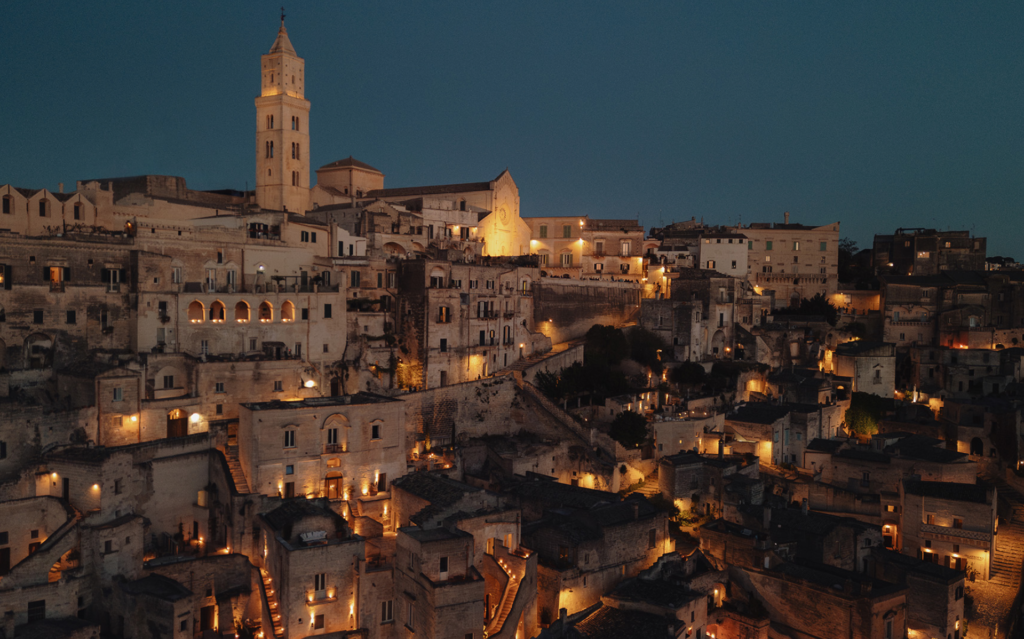
This may be Matera’s most extraordinary hour. Lights appear one by one across the Sassi, tracing windows, stairways and cave entrances until the entire hillside begins to glow. The ravine beyond becomes almost invisible, leaving the illuminated city suspended against blackness. Seen from a terrace, Matera can suddenly resemble a vast nativity scene or an ancient settlement glimpsed in a dream.
Returning to one’s room means descending once again through Vetera’s passages and courtyards. For guests staying underground, the transition is especially powerful. The city disappears, a door closes and silence returns. There is an unusual emotional quality to sleeping within rock. Perhaps it is the thickness of the walls or the absence of ordinary urban noise. Perhaps it is simply the knowledge that human beings have sought shelter in this landscape for an almost incomprehensible length of time.
Whatever the reason, Matera makes one conscious of time.
And Vetera makes that consciousness part of the luxury.
This is ultimately what distinguishes the hotel. Its most memorable qualities are not objects that could be transported elsewhere. The furniture may be beautiful, the service polished, the cuisine sophisticated and the spa exceptional, but none explains Vetera on its own. The experience comes from the relationship between all of them and the ancient architecture they inhabit.
The modern hotel industry often searches obsessively for originality. New concepts are invented, interiors designed around themes and experiences created in the hope of giving travellers something they have never seen before. Vetera demonstrates that originality can sometimes come from doing precisely the opposite: listening carefully to what has been there all along.
Matera already had the story.
The hotel’s task was not to rewrite it.
It was to become part of it.
MAISON BLANCHE REFLECTION
There are luxury hotels that impress us because of what they have created. Vetera Matera impresses because of what it had the confidence not to erase.
The ancient walls remain irregular. The stone retains its scars. Rooms follow the geography of another age. Courtyards still suggest the communal life that once animated them, and deep beneath the streets, water and silence occupy spaces carved into the earth long before contemporary ideas of wellness or luxury existed.
That restraint gives Vetera something far more valuable than perfection: authenticity.
Perhaps this is what the future of luxury travel should increasingly become. Not a collection of beautiful hotels that could exist anywhere in the world, but places so profoundly connected to their surroundings that moving them elsewhere would make no sense at all.
Vetera could only belong to Matera.
And Matera, in return, gives the hotel something no architect, designer or hospitality group could ever manufacture: thousands of years of memory.
To stay here is not simply to visit one of Italy’s most extraordinary cities. It is to wake within its stone, walk through its history, taste the landscape surrounding it and, for a few nights, become a very small part of a story that began long before us and will continue long after we leave.