
On a quiet street in Los Angeles, Mehrshad Khalili – known to friends as Mersh – spends his days hunched over panels of deep‑black clayboard. Born in 1993 in Mashhad, Iran, he grew up amid stories of exile and reinvention. Today he lives and works in California, where he has developed a distinctive art practice that begins “where memory and existence blur”. Instead of adding pigment, Khalili removes it: his signature scratch technique involves carving lines into a matte surface, slowly revealing luminous images hidden beneath.
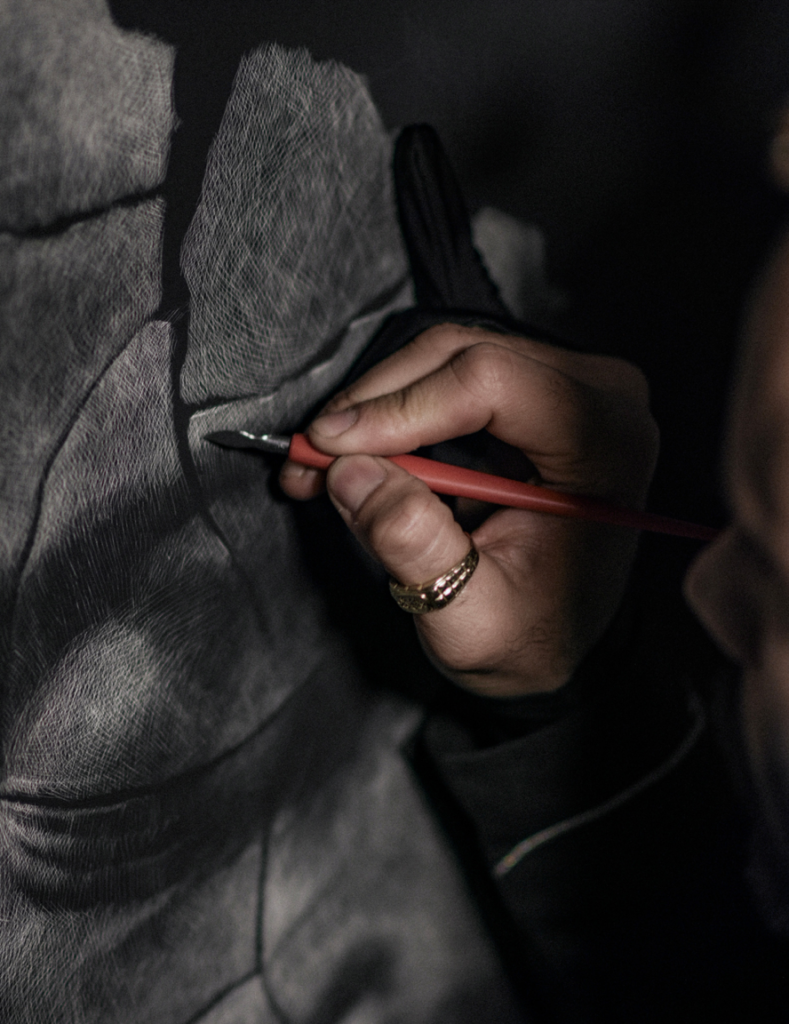
Scratch as excavation
Khalili’s process is meditative and physical. Each piece starts with a blank, velvety panel coated in ink. He then excavates the image line by line, scraping away the darkness to uncover figures, landscapes and symbols that seem to pre‑exist the act of drawing. The technique demands patience and resolve; one mistaken mark cannot be undone. Khalili likens scratching to sculpting and archaeology: it is an act of removal, of reducing a surface until a hidden narrative emerges. The resulting works straddle drawing, engraving and sculpture.
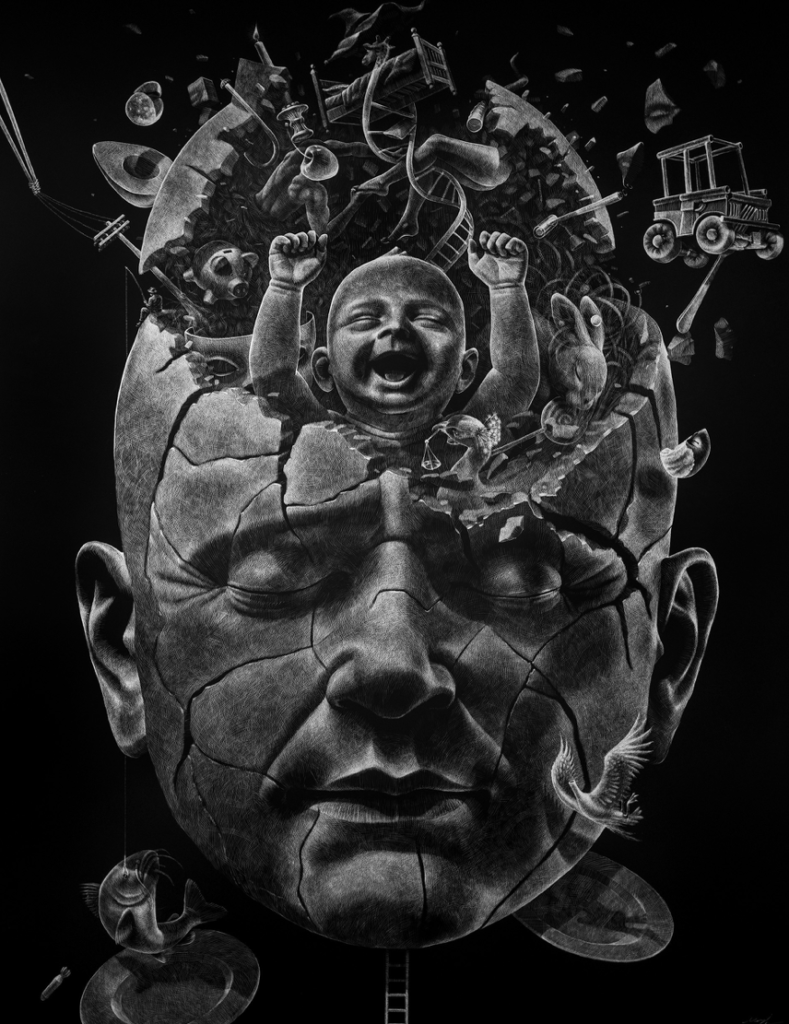
Themes of fragility and innocence
Khalili’s recurring imagery often centres on babyhood and vulnerability. He sees infants as potent symbols of purity and fragility, and his sculptural forms are inspired by toys and cots. The scratches trace the contours of sleeping babies, ghostly animals and mythic creatures, all rendered with an architectural precision that betrays his background in architecture. This training lends his work a structural clarity; rigorous grids and complex geometry anchor compositions that might otherwise float into dreamscapes. The tension between raw symbolism and deliberate design gives the pieces their power, inviting viewers to oscillate between visceral emotion and cerebral appreciation.
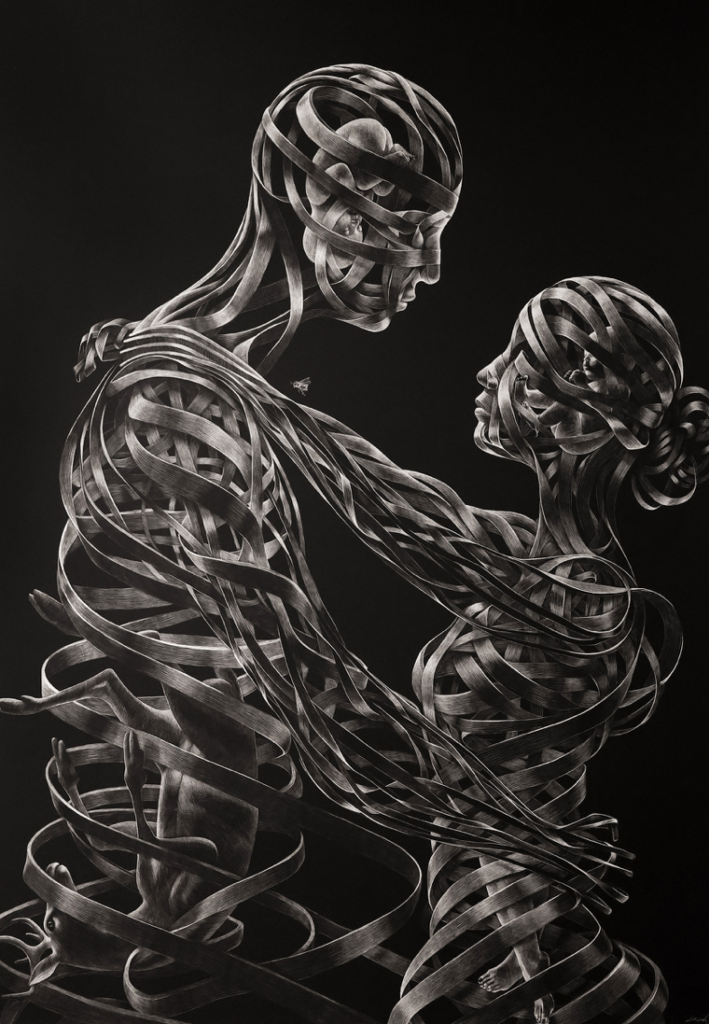
Beyond the panel
While scratchboard art is Khalili’s hallmark, he also experiments with installation and performance. He sometimes creates immersive environments where viewers are invited to touch textured surfaces or listen to soundscapes that accompany the images. His interest in the subconscious and the fragile boundary between presence and absence – “uncovering images that feel as if they have always existed beneath the surface” – links his work to movements such as surrealism and arte povera, but his execution is unique. Khalili’s lines shimmer like silver threads, conjuring narratives without words.
After exhibiting across California and gaining a following on social media, Khalili remains grounded. He describes his art as a search for truth rather than a career choice. “I take matte black canvases and I excavate the art from it,” he once said, “as if I’m digging out memories.” In a world saturated with glossy images, his scratched surfaces and quiet figures remind us that creation can also be an act of patient uncovering.