
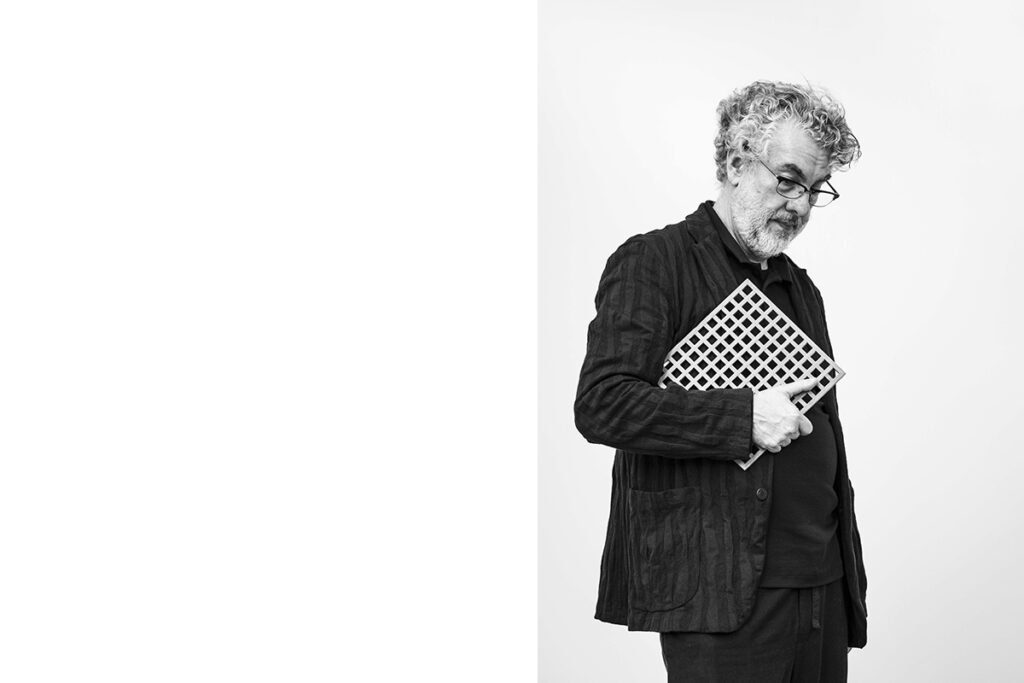
Brazil’s contemporary architecture scene owes much to Marcio Kogan, the São Paulo–based architect and filmmaker who has spent four decades honing a language of relaxed minimalism. Born in 1952 to engineer‑architect Aron Kogan, whose skyscrapers like the Mirante do Vale and São Vito once dominated São Paulo’s skyline, Marcio grew up surrounded by construction sites. He studied at the School of Architecture and Urbanism at Mackenzie Presbyterian University, graduating in 1976.
From film to architecture
Kogan’s early career was divided between cinema and architecture. In partnership with his university friend Isay Weinfeld he produced the feature film Fire and Passion in 1988 and held exhibitions exploring architecture and humour throughout the 1990s. This cinematic background still infuses his architecture: his houses often unfold like film sets, with long corridors that frame views and dramatic transitions between light and shadow. In 2001 Kogan renamed his practice Studio MK27, marking a renewed focus on architecture and a collaborative approach. The studio has since become one of Latin America’s most influential firms, with projects in Brazil, Singapore, Spain, Canada, the United States and Puerto Rico.
A language of simplicity and comfort
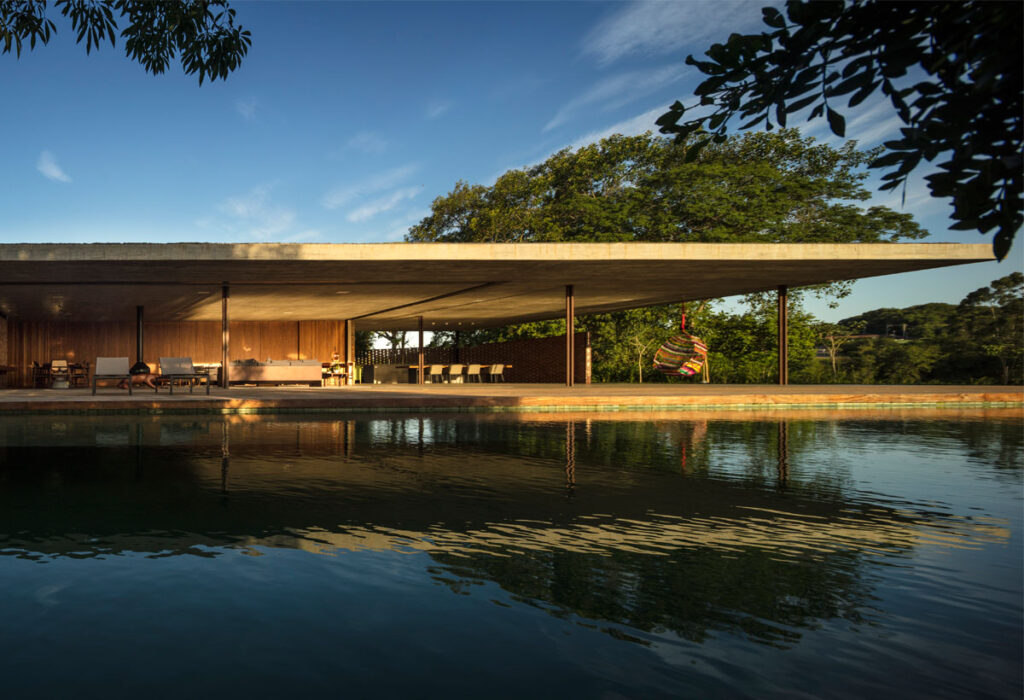
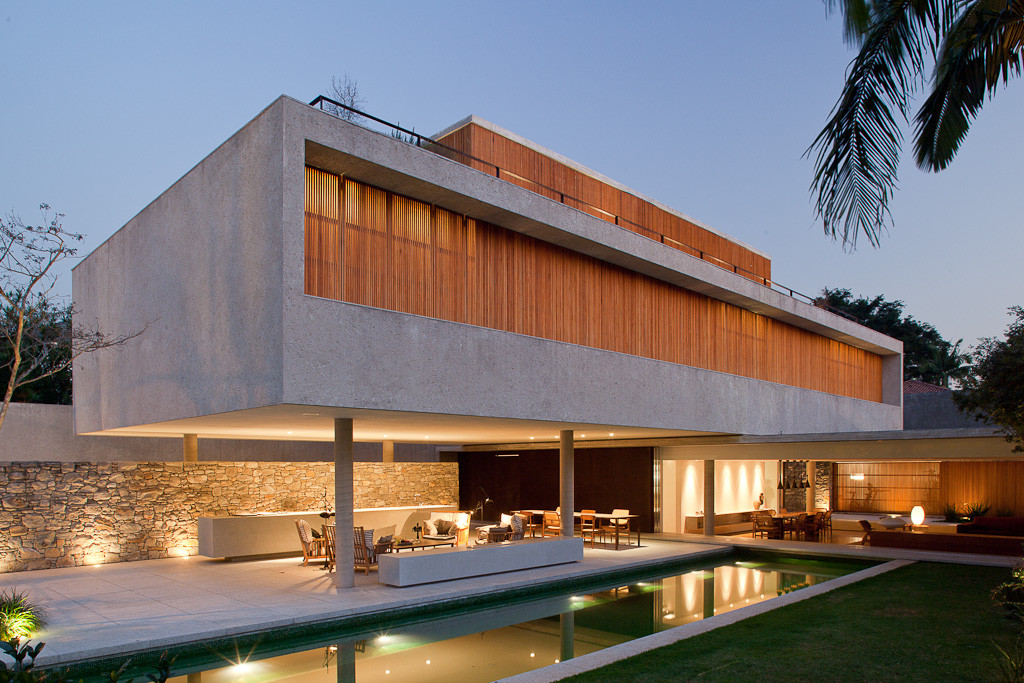
Critics and clients praise Kogan’s work for its architectural detail, formal simplicity and strong relationship between interior and exterior. Many projects use pure volumes, generous cantilevers and floor‑to‑ceiling glass to create an impression of lightness. Sliding panels and wooden screens (known as mashrabiyas) modulate light and privacy. Passive sustainability is central: houses are oriented to capture breezes and are shaded by large eaves, ensuring climatic comfort without heavy mechanical systems. Materials are left raw — exposed concrete, warm tropical hardwoods and rough stone produce tactile richness.
Kogan openly cites his admiration for mid‑century Brazilian modernism and the work of Oscar Niemeyer. Yet his architecture is more restrained than Niemeyer’s sensual curves; it focuses on rectilinear forms and the gentle interplay between inside and outside. Each project, whether a beachfront villa or a high‑rise in Singapore, embodies a sense of calm.

International recognition
Studio MK27’s work has been published worldwide and has won numerous awards. In 2011 Marcio Kogan was named an Honorary Member of the American Institute of Architects (AIA) for his body of work. In 2012 the studio represented Brazil at the Venice Biennale of Architecture, affirming its place on the global stage. The firm’s projects have also garnered attention from critics such as Paul Goldberger, who in 2013 described Kogan as one of the principal references of Brazilian contemporary architecture.
A cinematic sensibility
Kogan’s background in filmmaking continues to influence his design process. He storyboards projects like films, choreographing the way occupants will move through spaces and experience changing frames of landscape. He often collaborates with photographers and cinematographers to document his buildings, ensuring that their narrative qualities are captured on film. In his own words, architecture is “about light, time and emotion” — a philosophy that unites his two careers.
From a boy watching his father’s towers rise over São Paulo to an architect whose houses are celebrated worldwide, Marcio Kogan has carved out a distinct voice. His work invites us to slow down, open the sliding doors and let the breeze in. It reminds us that modern architecture need not be monumental to be memorable; sometimes the most powerful spaces are those that simply frame everyday life with grace.